
Quick Answer
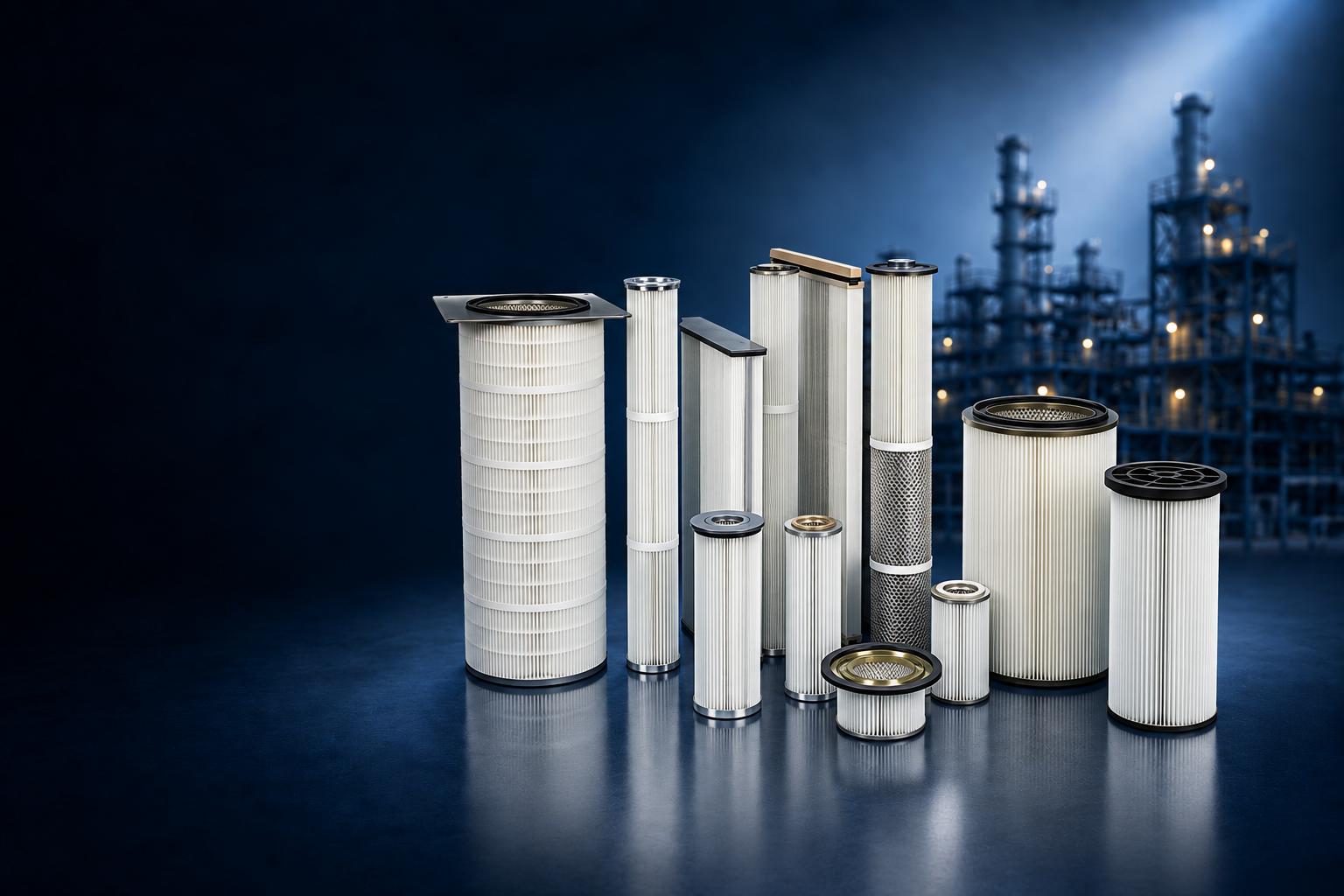
An industrial dust filter captures airborne particulate inside a dust collector or air filtration system. Sutez is an Industrial Dust Filter Manufacturer in India offering industrial filtration products for dust collection and air-handling applications. The right filter is selected from the actual dust, airflow, temperature, moisture, filtration area, differential pressure, cleaning method and equipment dimensions—not from filter size alone.
Industrial dust filtration looks simple from outside: dirty air enters, dust is captured and cleaner air leaves. In practice, filter life and airflow depend on several small details. Fine dry powder behaves differently from fibrous dust. A hot process cannot be treated like an ambient-temperature application. Moist or oily dust can blind a filter that works perfectly on dry material. That is why a replacement should be matched to the process, not only copied by length and diameter.
Industrial Dust Filters, Dust Collector Filters, Industrial Air Filtration, Cartridge Filters, Bag Filters, Differential Pressure, Dust Loading, Filter Media, Pulse-Jet Cleaning
Core Products:
Industrial Air Cartridge Filters, Bag Filters, Filter Elements, Panel Filters, Industrial Filtration Solutions
For buyers, the practical goal is not simply to find the finest filter. The filter has to capture the required particulate while maintaining workable airflow and pressure drop in the equipment. If the media is too restrictive, the system can lose airflow. If the media or construction is unsuitable for the dust, it may clog, leak, deform or require frequent replacement.
Sutez manufactures and supplies industrial filtration products in India, including industrial air cartridge filters, bag filters, filter elements and panel filters. For a dust-filter enquiry, useful application information includes the existing filter size, dust type, airflow, operating temperature, humidity or moisture, cleaning arrangement, quantity and any available drawing, sample or equipment details.
“Start with the dust and the operating condition, not only the micron number. Airflow, temperature, moisture and the cleaning method often decide whether a filter works comfortably or blocks too early.” — Sutez Technical Team
Table of Contents
- What Is an Industrial Dust Filter?
- Types of Industrial Dust Filters
- Why Correct Filter Selection Matters
- Applications of Industrial Dust Filters
- Industries That Use Dust Filtration
- Technical Specifications & Buyer Selection Guide
- Maintenance and Replacement Tips
- Why Source Dust Filters from Sutez?
- Frequently Asked Questions
What Is an Industrial Dust Filter?
An industrial dust filter is a filtration component used inside a dust collector, extraction unit or air-handling system to separate airborne particles from moving air. Dust collects on or within the filter media while air passes through. In many collectors, the filter is cleaned periodically by pulse-jet air, shaking, reverse air or another equipment-specific method so the system can continue operating.
What determines whether a dust filter is suitable?
- Type, size and behaviour of the dust particles
- Air volume and air-to-media loading
- Normal and peak operating temperature
- Humidity, condensation, oil or sticky contaminants
- Chemical exposure and media compatibility
- Allowable differential pressure across the filter
- Cleaning method used by the dust collector
- Filter dimensions, sealing arrangement and installation style
A filter that physically fits can still be wrong for the process. This is one of the most common replacement-filter mistakes.
Types of Industrial Dust Filters
1. Industrial Air Cartridge Filters
Cartridge filters use pleated media to provide filtration area in a compact form. They are used in dust collectors designed for cartridge elements. The pleat geometry, media, end caps, gasket arrangement and cleaning behaviour should match the collector and dust characteristics.
2. Bag Filters
Bag filters are used in baghouse and dust collection systems built around tubular, sleeve or other bag-style elements. Media selection depends on temperature, dust chemistry, moisture, cleaning method and the mechanical design of the collector.
3. Panel and Pre-Filters
Panel filters may be used in ventilation or staged air-filtration systems to capture larger particulate before finer filtration stages. Their role is different from a pulse-cleaned dust collector cartridge, so the application should be identified clearly when ordering.
4. Replacement Filter Elements
Replacement elements should match the existing equipment dimensions and sealing arrangement, but dimensions are only the starting point. Media type, filtration area, dust release, temperature capability and cleaning compatibility also matter.
Why Correct Dust Filter Selection Matters
1. Stable Airflow
A correctly selected filter helps the dust collector maintain the airflow needed at the extraction point without creating unnecessary resistance.
2. Manageable Differential Pressure
Pressure drop normally rises as dust builds on the media. Suitable media, enough filtration area and effective cleaning help keep this rise within the equipment's workable range.
3. Better Dust Release During Cleaning
Dust that releases poorly from the media can remain embedded after cleaning. Surface treatment, media construction and dust characteristics can affect how easily the cake releases.
4. Practical Filter Life
Filter life is not a single fixed number. It changes with dust loading, operating hours, cleaning frequency, moisture, temperature, system balance and maintenance. Looking only at purchase price can be misleading if filters block too quickly.
5. Correct Fit and Sealing
Even good filter media cannot perform properly if the element does not seat or seal correctly. Gasket position, end-cap style, mounting hardware and dimensional tolerance should be checked against the collector.
6. Compatibility with Process Conditions
Heat, moisture, chemicals, oil and abrasive dust can change the media requirement. The operating environment should be stated before selecting a material.
7. Easier Troubleshooting
When the original operating data is recorded, it is easier to diagnose high pressure drop, frequent cleaning, dust leakage or unexpectedly short filter life later.
Applications of Industrial Dust Filters
Powder Handling and Mixing
Mixing, charging, conveying and packing of dry powders can release airborne dust. Local extraction and a suitable dust collector help capture particulate near the source.
Grinding, Cutting and Surface Processing
Grinding, machining, cutting, sanding and similar operations can create fine or abrasive dust. Filter media and collector design should account for particle size, loading and abrasion.
Cement, Minerals and Bulk Solids
Bulk-material transfer points, silos, crushers, packing lines and handling systems may generate high dust loads. Adequate filtration area and effective cleaning become especially important in these duties.
Pharmaceutical and Chemical Processing
Process dust can vary widely in particle size, moisture sensitivity and chemical behaviour. Material compatibility and the plant's containment or hygiene requirements should be defined before filter selection.
Food and Ingredient Processing
Flour, spices, starches, sugar, additives and other powders can create airborne particulate during transfer or processing. Filter choice must suit the dust, cleaning practice and equipment design.
General Engineering and Manufacturing
Fabrication, component manufacturing, foundry-related processes and production lines may use dust extraction for housekeeping, equipment protection or process control. The exact filtration requirement varies by source.
For related Sutez products, buyers can also review industrial air cartridge filters, bag filters, filter elements and panel filters.
Industries That Use Dust Filtration in India
Industrial dust filtration is used wherever a process creates airborne particulate that needs to be captured through an extraction or air-filtration system. The filter design is application-specific; the same element should not be assumed suitable across unrelated industries.
- Pharmaceuticals: Powder handling, granulation-related extraction and process dust control where the plant specification requires filtration.
- Chemicals: Dust capture from dry ingredients, blending, transfer and packing with attention to chemical compatibility.
- Food Processing: Flour, spices, starch, sugar and ingredient dust collection subject to the plant's hygiene and safety requirements.
- Cement & Minerals: High-dust material handling, crushing, conveying, storage and packing applications.
- Metal & Engineering: Grinding, cutting, polishing, machining and fabrication dust extraction.
- Woodworking: Sawing, sanding and machining dust collection with attention to dust characteristics and the system's safety design.
- Plastics & Composites: Trimming, grinding, powder handling and process extraction.
- General Manufacturing: Central or point-source dust collection around production equipment and material transfer areas.
Safety note: Some industrial dusts can present fire, explosion, toxicity or health hazards. Filter selection is only one part of the system. Hazard assessment, collector design, ducting, grounding, isolation, ventilation and other controls should be handled according to the actual process and applicable site requirements.
Technical Specifications & Buyer Selection Guide
When contacting an Industrial Dust Filter Manufacturer in India, sending complete process data usually saves more time than sending only a filter photo. A photo is helpful, but it does not show airflow, temperature, dust loading or cleaning conditions.
Dust Type and Particle Behaviour
Describe what the dust actually is: dry powder, fibrous, abrasive, sticky, oily, hygroscopic or mixed. If particle-size information is available, include it. Fine dust and coarse dust can require different media and filtration-area decisions.
Airflow and Dust Loading
Share the system airflow in the unit used by your plant and, if known, approximate dust concentration or loading. High dust loading may require more filtration area or more effective cleaning than a light-duty application.
Differential Pressure
If the dust collector has a pressure gauge or transmitter, record clean and operating differential pressure. This is often more useful than simply saying “the filter is choking.”
Filter Media
Common industrial systems may use different polyester-based or specialty media, surface treatments or membranes depending on the dust and process. Do not select media by name alone; temperature, moisture, chemical exposure, dust release and collector cleaning method should all be checked. Availability of a specific media option should be confirmed for the required filter.
Operating Temperature and Moisture
Provide normal and peak temperature, not only room temperature. Also mention steam, condensation, humidity, oil mist or washdown exposure. Moisture can turn otherwise free-flowing dust into a sticky cake.
Cleaning Method
Confirm whether the collector uses pulse-jet compressed air, reverse air, shaking or another cleaning method. Media and element construction need to tolerate how the collector actually cleans the filter.
Dimensions, End Caps and Gaskets
Record overall length, outside and inside diameters where relevant, flange or end-cap style, bolt or mounting details, gasket position and sealing face. A drawing is better than a handwritten size list when the fit is complicated.
Efficiency or Emission Requirement
State the required filtration efficiency, outlet target or project specification if one exists. Avoid using terms such as “HEPA,” “fine filter” or “1 micron” loosely unless the required performance and test basis are actually defined for the project.
Common Buying Mistakes to Avoid
- Ordering only by length and diameter because the old filter “looks the same.”
- Choosing the smallest micron number without checking airflow and pressure drop.
- Ignoring moisture, oil, temperature or chemical exposure.
- Not telling the supplier whether the collector is pulse-cleaned or mechanically cleaned.
- Changing media but keeping the same cleaning settings without checking system response.
- Assuming one filter media is suitable for every dust produced in the plant.
- Sending a photo but no dimensions, drawing, equipment model or operating data.
A slightly unglamorous but useful tip: measure the old filter before it is thrown away. Once the used element is gone, small details such as gasket location, end-cap depth or mounting hardware are easy to forget and surprisingly annoying to reconstruct.
Maintenance and Replacement Tips
- Track differential pressure and airflow trends instead of relying only on visual inspection.
- Check pulse-jet valves, compressed-air quality and cleaning controls if filters remain heavily loaded.
- Inspect gaskets, mounting surfaces and clamps for bypass leakage or poor sealing.
- Look for torn media, damaged pleats, collapsed elements, abrasion or loose end caps.
- Investigate moisture or sticky deposits before repeatedly replacing filters with the same specification.
- Do not use aggressive cleaning methods unless the filter construction is intended for them.
- Replace filters when damage, persistent pressure drop or loss of performance cannot be corrected through the approved maintenance procedure.
There is no sensible universal rule such as “replace every three months.” Two identical filters can have very different service lives if dust loading, operating hours, cleaning air or humidity are different.
Why Source Industrial Dust Filters from Sutez?
Sutez is an India-based manufacturer and supplier of industrial filtration products. The product range shown on the Sutez site includes industrial air cartridge filters, bag filters, filter elements, filter housings and panel filters. For a dust-filtration enquiry, the useful next step is to match the requested element to the collector and operating condition rather than treating it as a generic spare.
- Industrial air cartridge filters for compatible dust collection and air-filtration equipment.
- Bag filters for systems designed around bag-style filtration elements.
- Filter elements and related filtration components for industrial applications.
- Panel filters for relevant air-filtration and staged filtration duties.
- Application discussion based on dimensions, dust type and operating information supplied by the buyer.
For a quotation, share the filter drawing or clear photos, complete dimensions, quantity, dust type, airflow if known, operating temperature, cleaning method and any current problem such as high pressure drop, dust leakage or unusually short service life.
Frequently Asked Questions
What is an industrial dust filter?
An industrial dust filter is a filtration component used in dust collection or air-handling systems to capture airborne particulate before the air is returned, exhausted or sent to the next process stage.
How do I choose the right industrial dust filter?
Start with dust type and particle size, then check airflow, dust loading, operating temperature, moisture, chemical exposure, filtration area, allowable differential pressure, cleaning method, dimensions and required efficiency.
What is the difference between a cartridge filter and a bag filter for dust collection?
Cartridge and bag filters use different shapes, media arrangements and filtration areas. The correct choice depends mainly on the dust collector design, available space, dust behaviour, temperature and cleaning method.
What specifications should I send for an industrial dust filter quotation?
Send the dust type, application, dimensions, quantity, airflow, operating and peak temperature, moisture, dust loading, current differential pressure if known, cleaning method, media requirement and a drawing, photo or sample when available.
Why does differential pressure increase across a dust filter?
Differential pressure usually rises as dust accumulates. It can also increase because of ineffective cleaning, unsuitable media, moisture, sticky dust, excessive airflow, blocked passages or a filter that is too restrictive for the system.
How often should an industrial dust filter be replaced?
There is no universal replacement interval. Use measured pressure drop, airflow change, visible damage, cleaning response, operating condition and the equipment maintenance procedure to decide when service or replacement is needed.
Can one dust filter media handle hot, oily and moist dust?
Not necessarily. Heat, oil, moisture, chemicals and sticky or abrasive particles affect filter media differently, so media and construction should be matched to the actual operating condition.
Does Sutez manufacture industrial dust filters in India?
Sutez is an India-based manufacturer and supplier of industrial filtration products, including industrial air cartridge filters, bag filters, filter elements and panel filters. Final selection should be confirmed against the dust, equipment and operating details.
Sticky Q&A: Quick Buying Answers
What should I send first: a sample, drawing or photo?
A drawing with dimensions is the clearest starting point. If it is not available, send clear photos and dimensions; a used sample can help confirm fitment details that are difficult to describe.
Is a lower micron rating always better for a dust collector?
No. Finer filtration can increase resistance if the media and filtration area are not matched to the airflow and dust load. Required efficiency and system pressure drop should be considered together.
Why is my new dust filter clogging faster than the old one?
Possible causes include different media, reduced filtration area, higher airflow, poor pulse cleaning, wet or sticky dust, changed process loading, compressed-air issues or a sealing and installation problem.
Can I replace the existing filter with a different media?
Sometimes, but the change should be checked against dust release, temperature, moisture, chemical compatibility, pressure drop and the collector's cleaning system before ordering.
Conclusion
Choosing an industrial dust filter is mainly an application-matching exercise. The filter has to fit the equipment, but it also has to work with the dust, airflow, temperature, moisture, cleaning method and acceptable pressure drop. Getting these basics right usually prevents more trouble than simply chasing a finer media specification.
If you are evaluating an Industrial Dust Filter Manufacturer in India for a new or replacement requirement, send Sutez the available filter drawing or dimensions, dust type, quantity, operating temperature, airflow and cleaning method. If the current filter is giving trouble, mention the actual symptom too—high differential pressure, leakage, short life or poor cleaning—so the requirement can be discussed with better context.